
By Aderonke Ojo
The President of the Nigeria Volleyball Federation (NVBF), Engr. Musa Nimrod, has announced that the federation will commence doping tests in the Premier League as part of a strong push to sanitize the sport and protect its integrity.
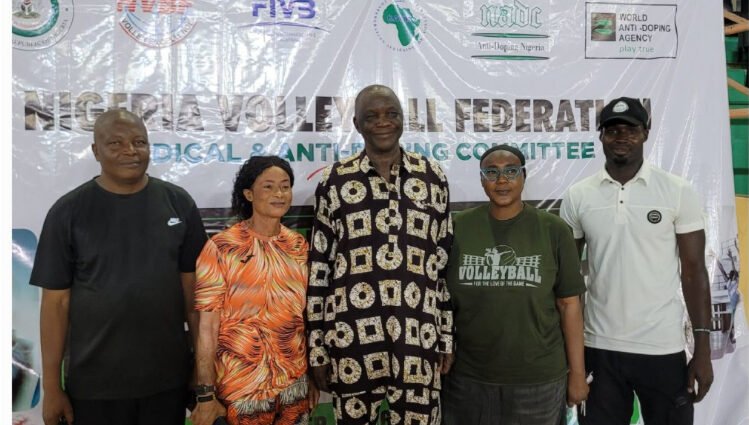
While Speaking shortly after the Anti-Doping Information and Education Seminar organised by the NVBF Nimrod said the initiative was designed to sensitise volleyball players on anti-doping rules and safeguard their careers in line with global best practices.
He described the seminar as a necessary step following directives from the last Nigerian Olympic Committee (NOC) Congress.
According to him, the NOC encouraged all federations to adopt a top-to-bottom approach to anti-doping, after a comprehensive presentation by the President of the NOC Anti-Doping Committee and medical experts.
He explained that Nigeria has now constitutionally fulfilled the requirements of the World Anti-Doping Agency (WADA), making it imperative for sports federations to take deliberate actions against the growing trend of athletes taking drugs or competing under the influence.
While admitting that the cost of full laboratory testing remains a challenge, Nimrod said the NVBF has resolved to partner with the National Drug Law Enforcement Agency (NDLEA) to conduct simple but effective checks on players.
“We are not joking about this,” Nimrod stated.
“For every international competition, we already conduct drug tests on our players before traveling. What we want to do now is to step it down to the domestic level, starting from the Premier League, to support the Federal and State Governments in curtailing drug abuse.”
The NVBF president noted that drug use often reflects clearly during matches, with some players starting games strongly before suddenly dropping in performance.
He stressed that such situations would now attract simple verification tests, carried out in collaboration with NDLEA officials. He also clarified that harmless substances like glucose drinks are allowed, but injections, marijuana or any substance taken to artificially boost performance will not be tolerated.
Nimrod expressed satisfaction with the turnout at the anti-doping programme, revealing that all participating teams were present alongside referees, officials and board members.
He described the exercise as an advocacy-driven initiative aimed at educating all stakeholders to prevent future conflicts when new regulations are enforced, such as restroom monitoring during matches.
He added that the anti-doping drive will help Nigeria avoid embarrassment at international competitions organised by the FIVB, CAVB, as well as events such as the African Games, Nations Cup qualifiers and the Commonwealth Games.
Beyond anti-doping, Nimrod highlighted the resurgence of volleyball in Nigeria, noting the growing interest witnessed during the Super Cup, including strong participation from schools.
He expressed confidence in grassroots development, revealing that Nigeria has been invited to participate in an upcoming Under-15 competition in Egypt, with the assurance that the country can also raise competitive Under-13 teams in the near future.
“With the right structure and discipline, volleyball will return to the glory days when it rivalled football for attention,” Nimrod said, reaffirming the federation’s commitment to clean sport, youth development and international competitiveness.